
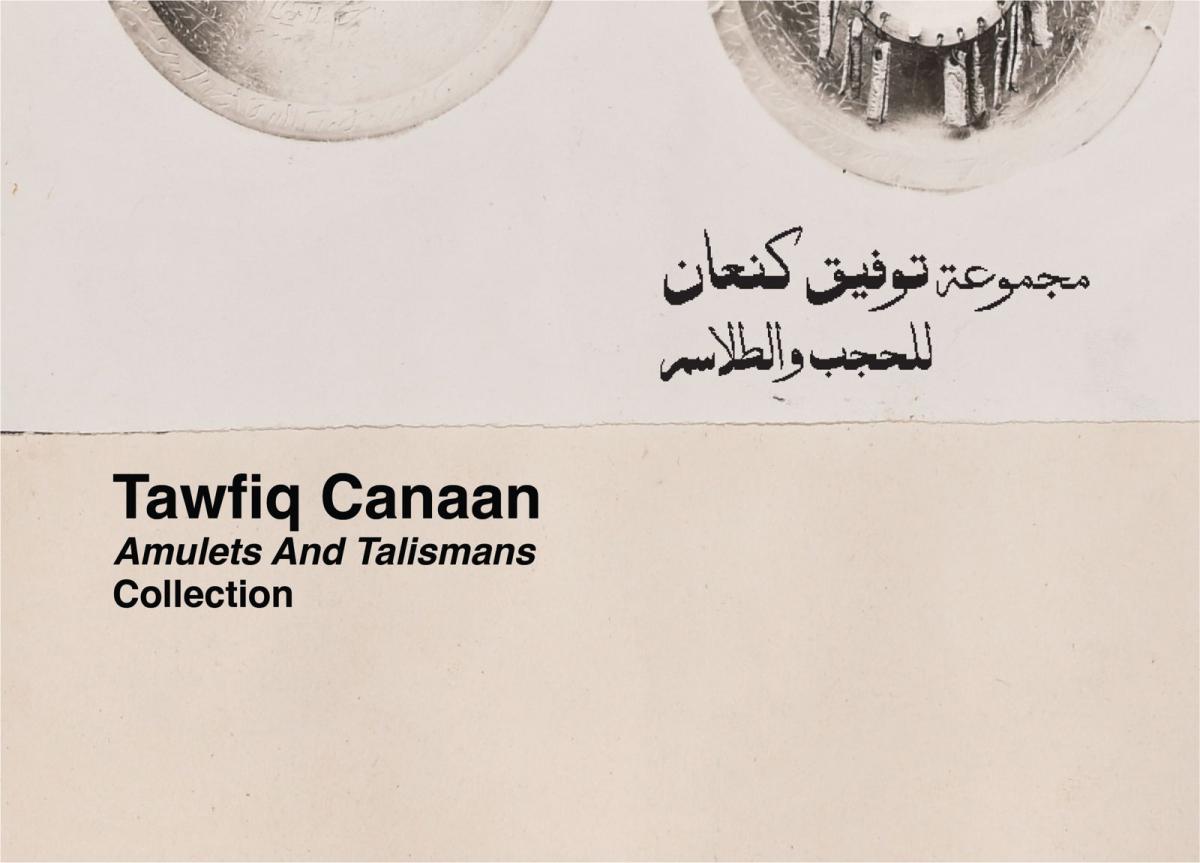
Tawfiq Canaan as a doctor and an ethnographer devoted his life to healing and his collection embodies this spirit and all of his fascinating contradictions. We shall draw connections and threads between the poetics of the artists and the foundational ethnographic work of Canaan in this iteration of the ongoing displays.
The Tawfiq Canaan Amulets and Talismans Collection is one of the most important (if not the most important) ethnographic collection in and about Palestine. The Canaan Collection contains more than 1380 pieces, one of the largest such collections globally. As an ethnographer, a man of medicine, and a local historian, Tawfiq Canaan collected in his life and meticulously documented every part of his work. Born in 1882 in Bayt Jala and educated in the American University of Beirut in medicine, Canaan opened his medical clinic in Jerusalem in 1912. As his practice grew, so did his interest in folklore, folk medicine, and archeology. His work and this collection provide necessary keys to help us understand Palestinian ways of being in the past, present and future.
In 1996, the Canaan family restored this important collection to the Palestinian people by donating it to Birzeit University believing in the prestigious standing of BZU as a foremost academic Palestinian institution, where the collection would be safe and well propagated.
Through our active engagement with the intellectualism of Tawfiq Canaan as a foundational actor in the growing field of Palestine and Palestinian studies, Birzeit University Museum aims to engage the BZU Museum collections as a pedagogical tool, alive and present. As part of the Hakawi al-Mathaf, Birzeit University Museum has been conducting a series of workshops offered to both students within BZU and to the general public since 2022.
Each part of BZU Museum’s work -- from the Reading/Research Room through the Collections Room and into the gallery space of ongoing displays -- is born out of the principle that Palestine teaches.