
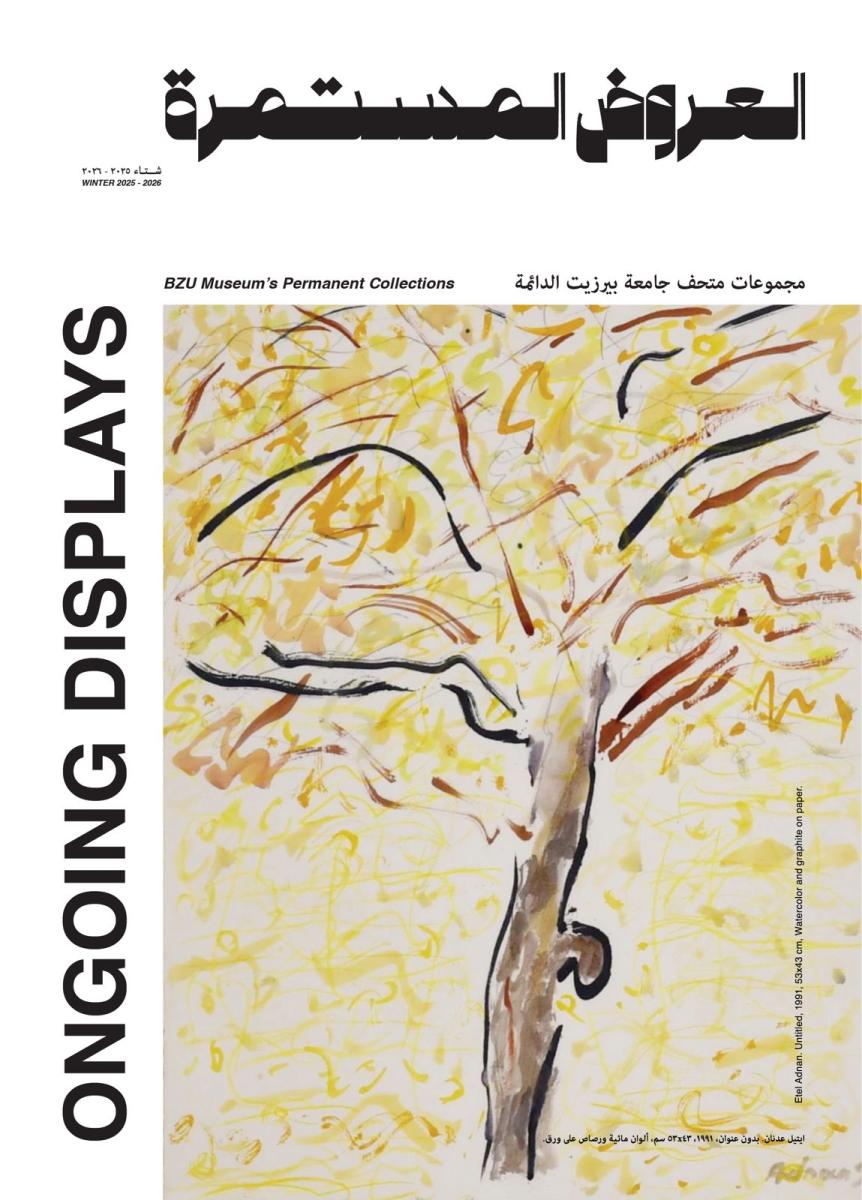
In 2025, BZU Museum commemorated twenty years in Birzeit University. Coinciding with the centennial of the university, BZU Museum marks this extraordinary occasion with our Ongoing Displays of BZU Museum’s Permanent Collections.
Rather than follow the conventional form of an exhibition as an event, these displays are in conversation with work generated through BZU Museum’s Reading/Research Room’s activities. Between the rigorous work of the BZUM Collections survey and subsequent collections care methodology, BZUM brought the responsibility of care into discussion with the necessity of relevancy. Exhibition practice in Palestine has a long and rich history that follow the historical evolution of Palestine as a cause, Palestine as a case, and Palestine as an idea and paradigm. The work of BZU Museum is a reflection of this multifaceted journey.
BZU Museum, as a central site of pedagogical practice with Birzeit University, works to show how decolonizing is an intellectual, creative and practical endeavor. Towards this end, BZU Museum’s gallery, in these ongoing displays of the permanent collections, is transformed into a space to share the process and practice of intellectualism as engagement. BZU Museum’s permanent collections include material in the Art Collection and the Tawfiq Canaan Amulet and Talisman Collection as well as the Textile Collection.
In this gallery full of displays, we invite people to explore a rich cultural journey. Sharing our ongoing work on the Tawfiq Canaan Talismans and Amulets Collection and Artists on Display. This experiment of displays (that grew out of the last two years of intense pedagogical engagement) shall be gathered under the larger rubric of "Healing" as we rely on Etel Adnan's watershed conceptualization in the poetics of the Arab Apocalypse. Placing Adnan in conversation with Kamal Boullata's foundational role as artist/critic and Marwan’s (Marwan Kassab-Bachi) looming influence on art as technique and storytelling, Sari Khoury’s return to Palestine through his art and, of course, Tawfiq Canaan’s ethnological interventions, we invite us all to journey with and through healing. To even consider healing as our collective wounds remain open and prey to the monsters of colonialism and capitalism, is an act of defiance.
What does it mean to collect, document and display under colonialism? Rather than answer this question, this experiment in displays of permanent collections centers the question as an ongoing engagement. Under the genocidal conditions and ongoing war against Palestine and Palestinians, preservation and exhibition can be reduced to a kind of capitulation, as memory has been weaponized to produce erasure.
We do not need to counter erasure, but rather, we covet life and this experiment on display is both a celebration of life and -- as healing -- an embodiment of grief and hope.